 |
CHAMÄLEON + ONJALA OBSERVATORY – LUNAR
ATLAS Segment 08 C |
back to OVERVIEW HOME CHAMÄLEON |
|
 |
|||
|
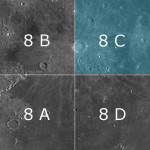
Segment 8
A Beer, Rima Hadley (Apollo 15) and Palus Putredinus Segment 8 B Wallace, Huxley and pyroclastic deposit Copernicus Segment 8 C The large domefields Milichius and Hortensius Segment 8 D Gruithuisen and putative plateaus north of Tobias Mayer |
| Moon age 10.5 - 10.6 days - Illumination 74 - 75 %
The large domefields Milichius and Hortensius south of the Carparthian Mountains and west of Copernicus |
Moon age 10.8 days -
Illumination 77 % NEW 2016 Domefield Milichius and Hortensius NEW 2016 Dome Hortensius H 7 - H 9 and 3 small Dark Halo Crater near Copernicus |
Moon age 12.3 days - Illumination 89 %
NEW 2016 Dark Halo Crater near Copernicus Kopernikus |
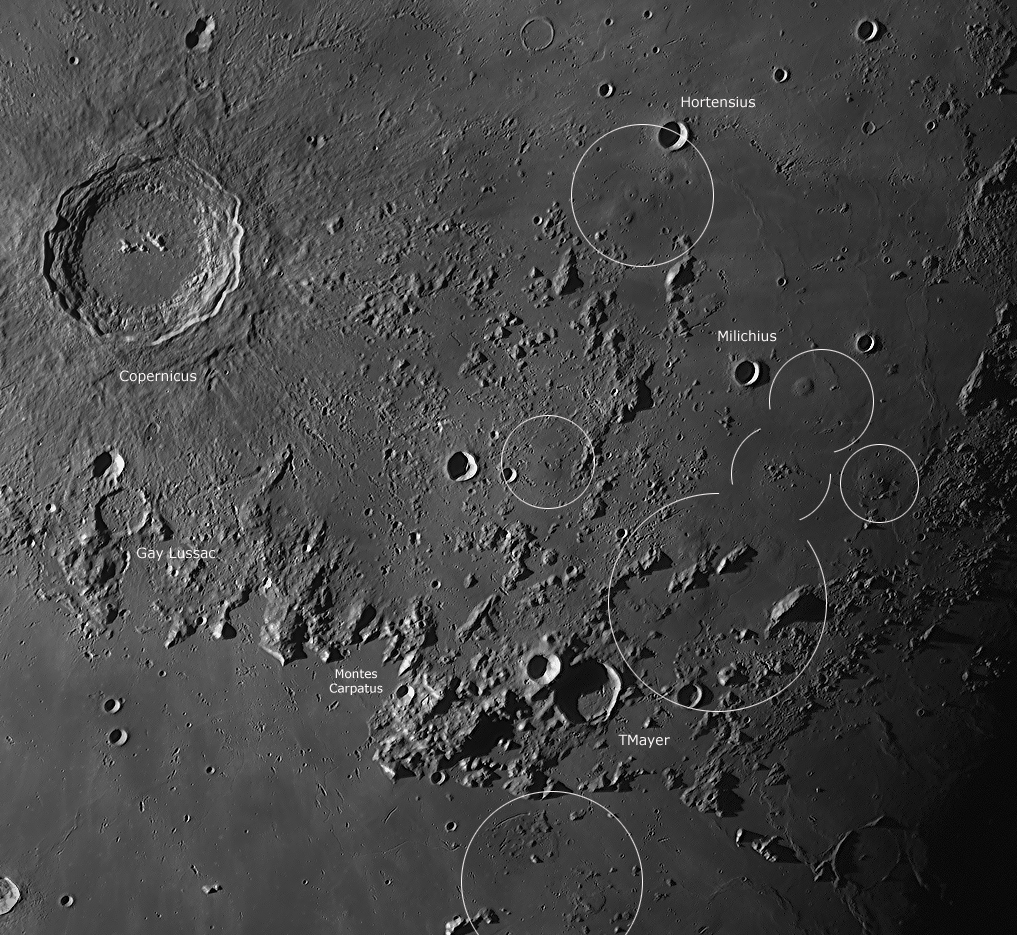 |
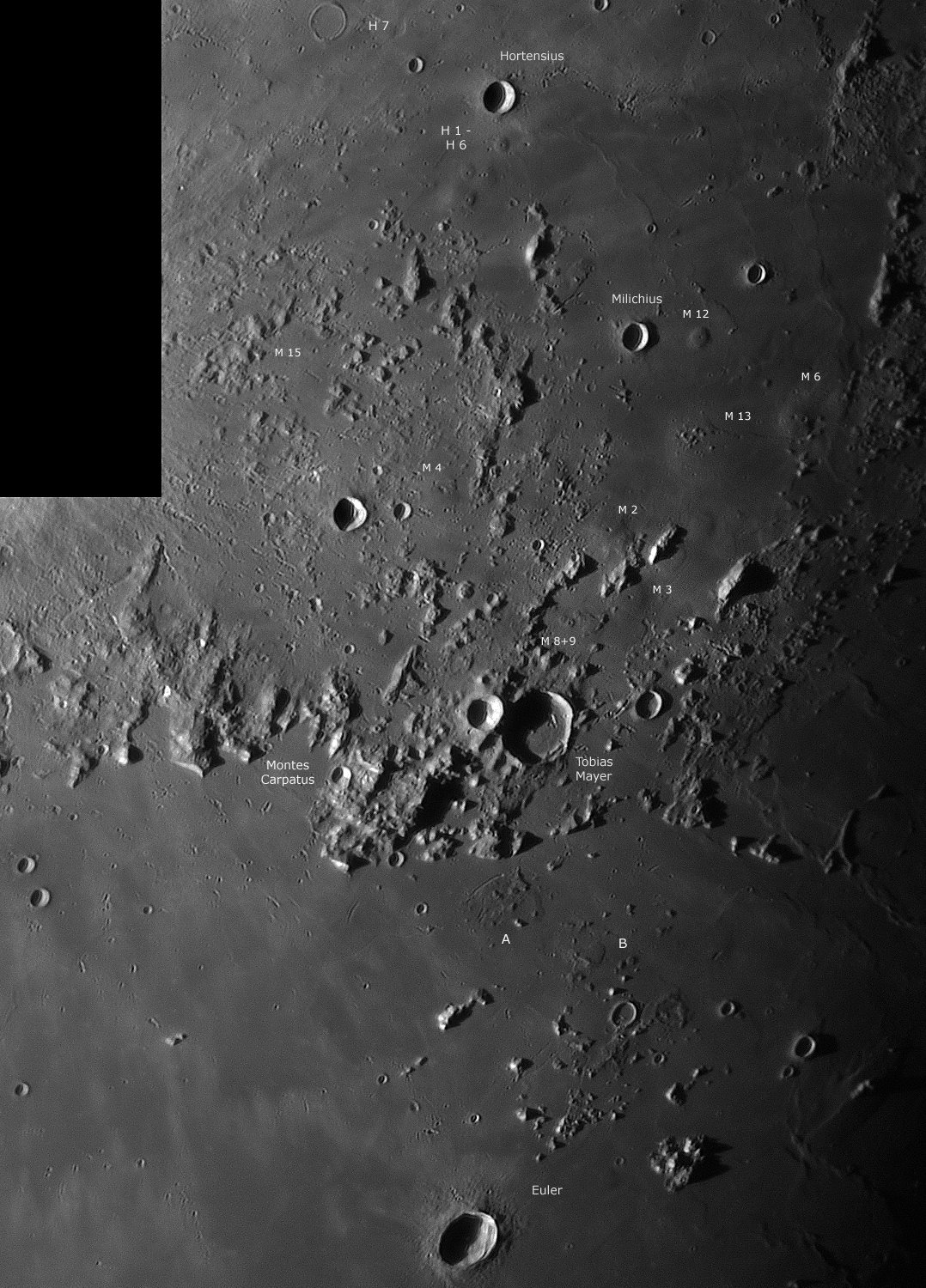
Hortensius and Milichius domefields The most famous domefields are undoubtedly near the small craters Hortensius (14.5 km) and Milichius (13 km). Both craters are in the west of Copernicus (93 km). To the north these fields extend up to the crater Tobias Meyer (33 km). The image to the left gives an overview of this "domeland". In total there are over 20 effusive domes of different diameters and heights in this region. In the lower part two putative plateaus. |
 |
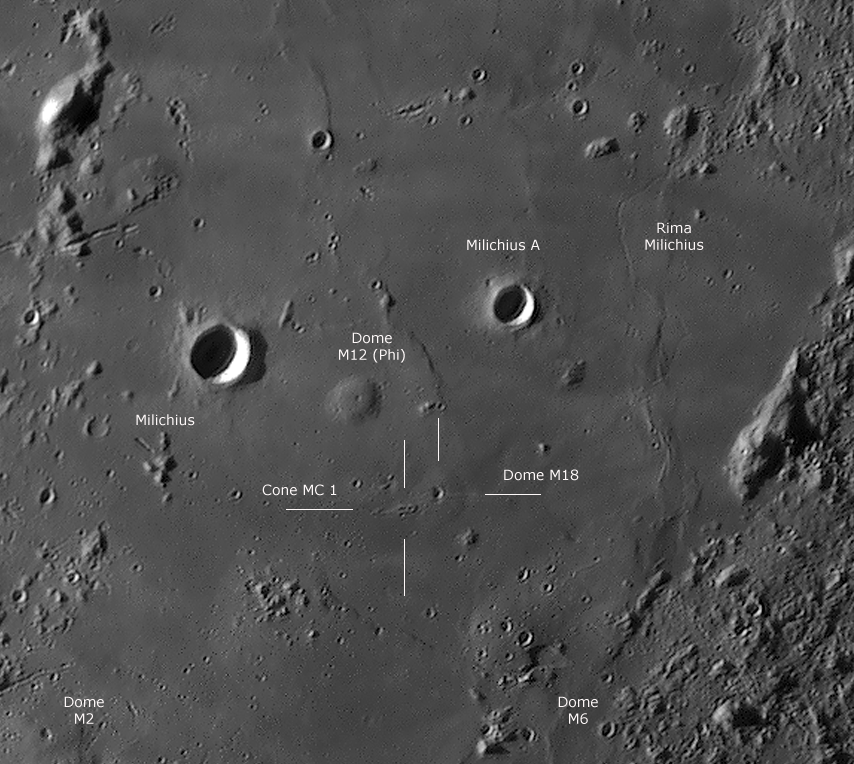
Cone Milichius MC 1 Next to the dome Milichius 12 (also known as Milichius Phi) you can find one of the few lunar cones which can be observed with amateur equipment. M12 has a dimeter of 10 kilometers and a height of 230 meters. MC 1 is located next to the flat Dome M 18 (12 km, height 90 meters) and is bisected by a linear rille. A further sinusoidal rille is also associated with this region (both are not visible in our image). MC 1 has a diameter of 1.8 kilometers and a height of about 60 meters. |
 |
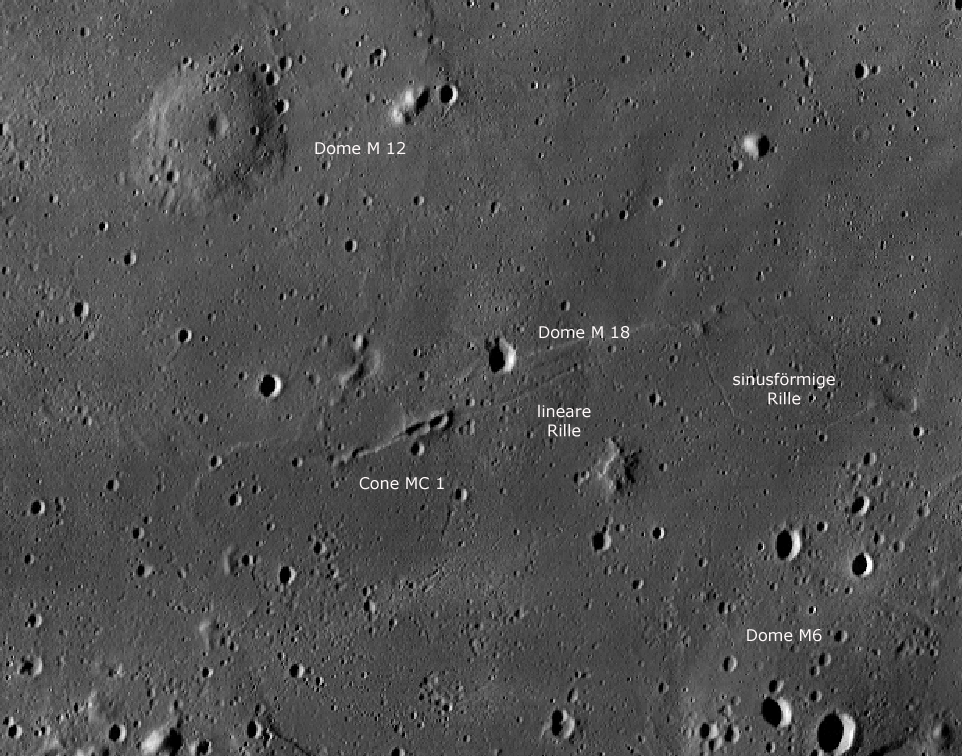 |
Cone Milichius MC 1
Two images of the coneMC 1 « « Our image, scaled by a factor of 1.5 and « the LRO image with a resolution of 64 m/px shows the two rilles. |
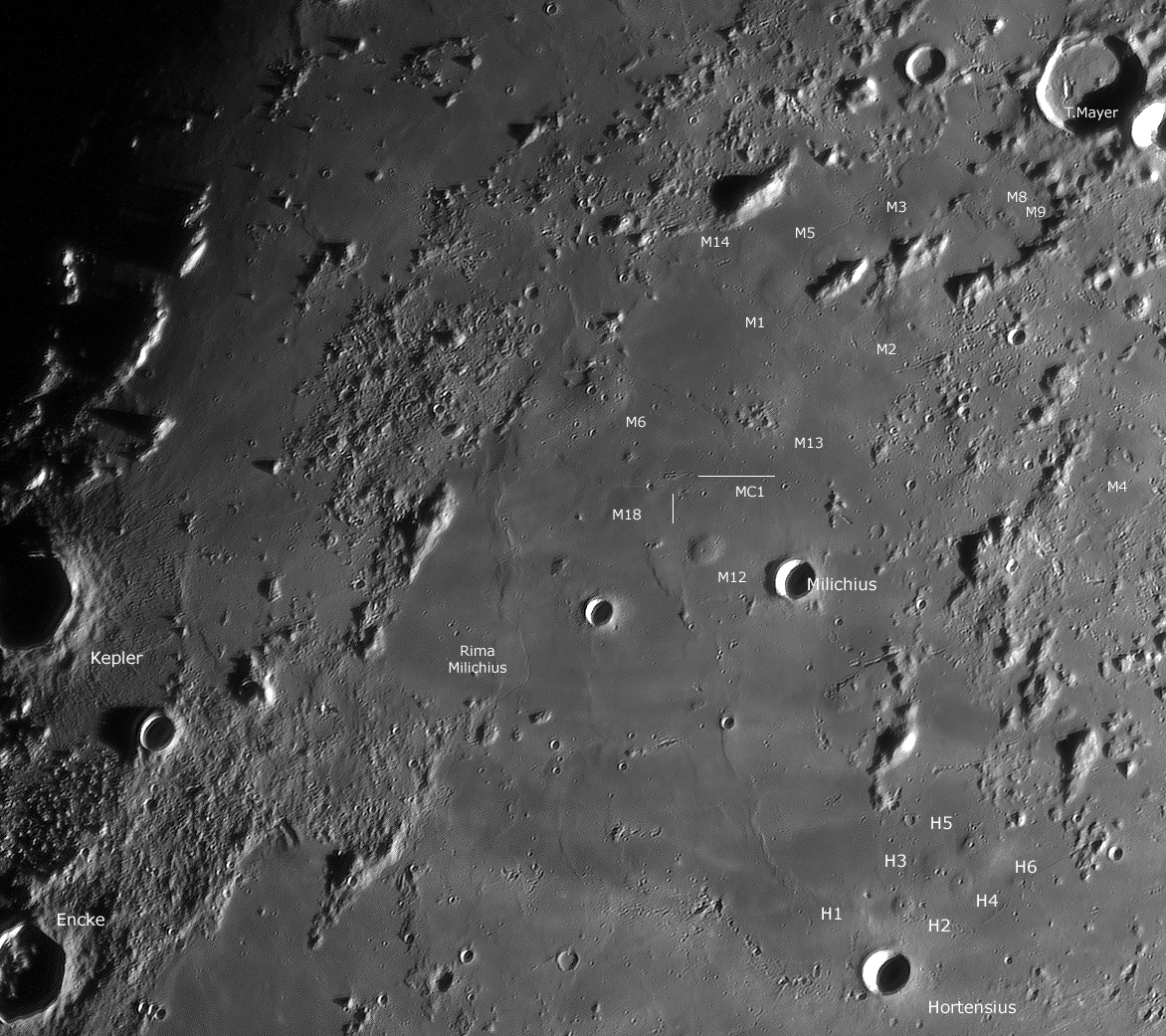 |
Hortensius- and Milichius domefields The image was captured with a 1.5x barlow lens on a Planewave astrograph (f = 4500 mm). We have marked some of the volcanic structures. Many of the domes show summit calderas. Near the domes M3 and M5 there are single lava flows and a very narrow sinusoidal rille. A further sinusoidal rille is Rima Milichius. The dome M18 has a diameter of 12 kilometers and a height of 90 meters. Next to it there are two lunar cones (MC1). Each of it with a diameter of 1.5 kilometers and a height of 60 meters. The slightest height in these fields has dome M14 with just 35 meters. |
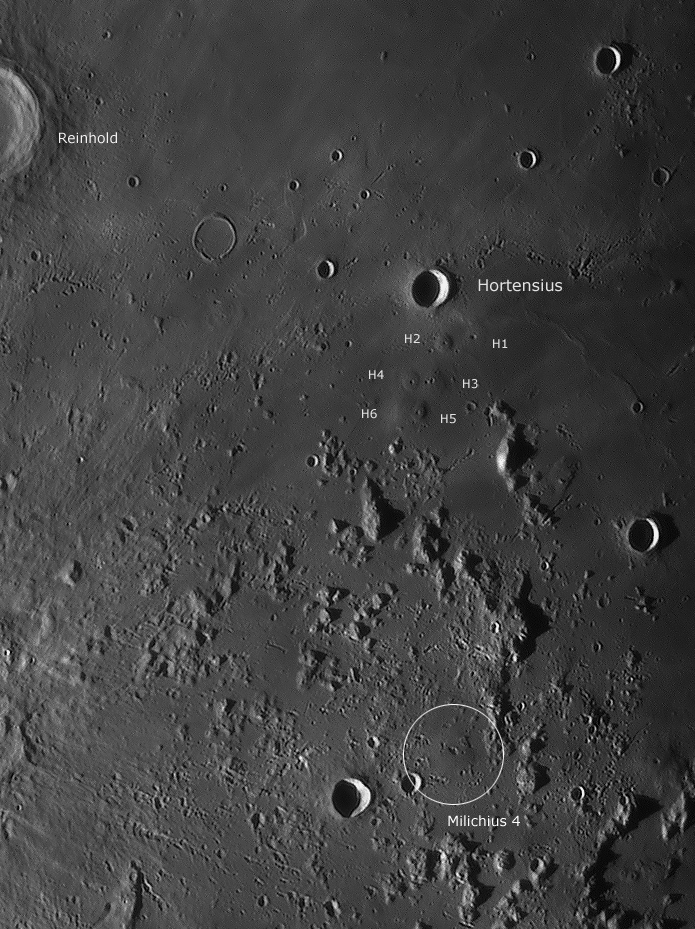 |
Hortensius domefield
Except H5 all Hortensius domes H1 to H6 have summit openings. Their diameters range from 8 to 12.5 kilometers, the heights between 100 and 400 meters. Milichius 4 is a medium sized dome with a diameter of 15 km and a height of 170 meters. It has a clearly resolved elongated caldera. |
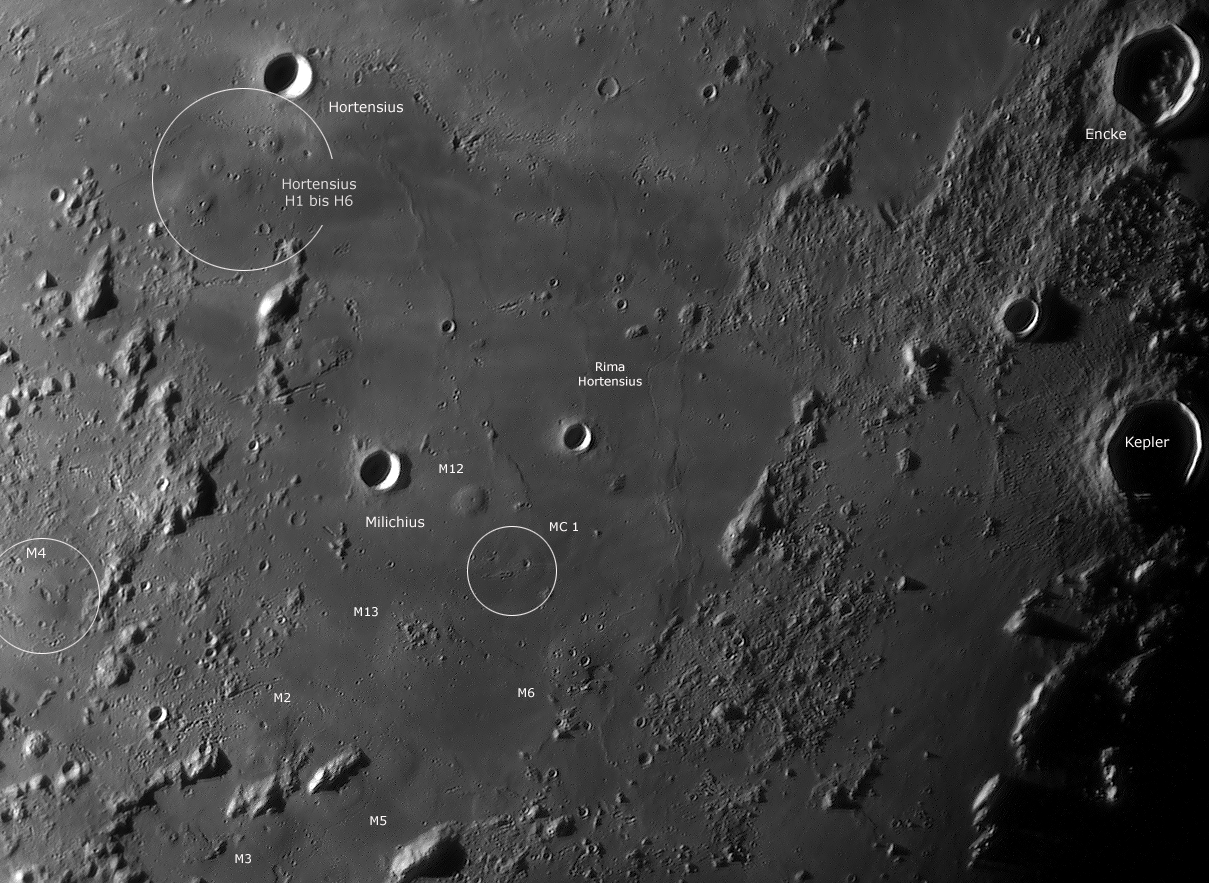 |
Hortensius and Milichius domefield The image shows the Hortensius domes H1 to H6, Milichius Phi and the cone MC 1 which is associated with M18. To the north there are some larger domes M2, M13 and M6. Their diameters are 20, 28 and 20 kilometers, their heights are about 320, 100 and 230 meters. The complex Dome M6 seems to be partly covered by a pyroclastic ash layer. See the image of the Kepler region in Segment 12. |
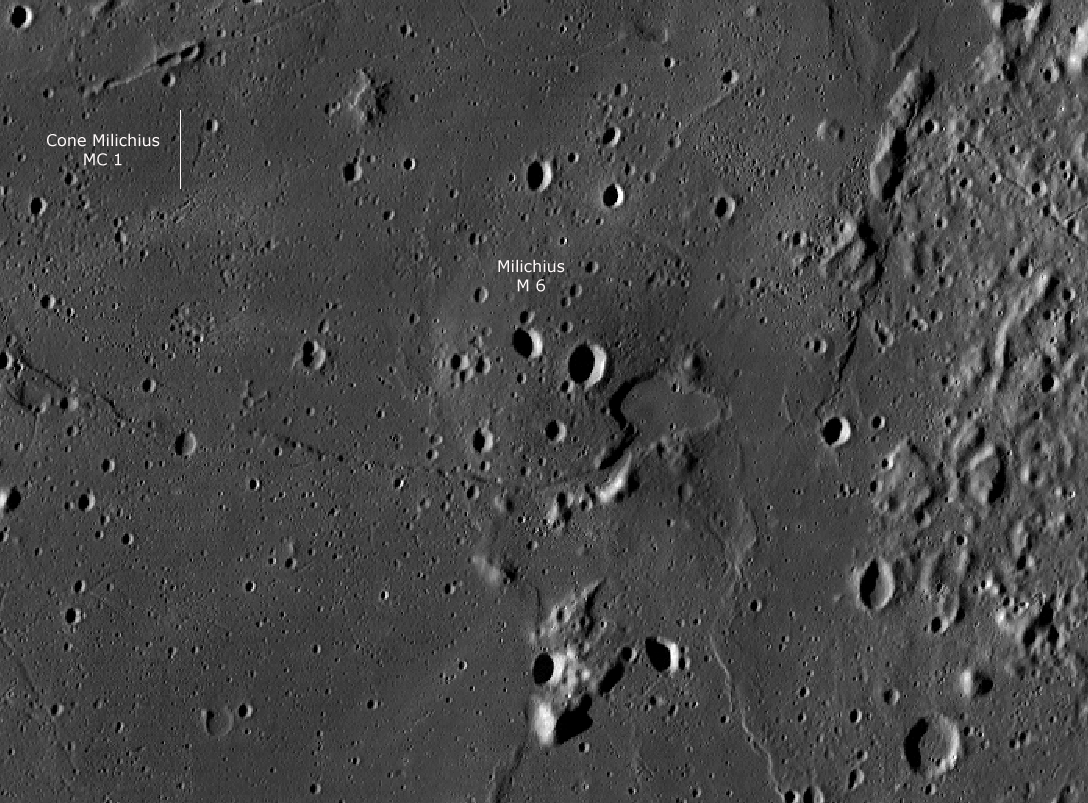 |
LRO Milichius M 6 This detailed image with of the LRO Wide Angle Camera shows the dome Milichius M6 with a large caldera and the outflow channel. Even dark pyroclastic ash deposits can be seen near the caldera. The image resolution is 64 m/px. |
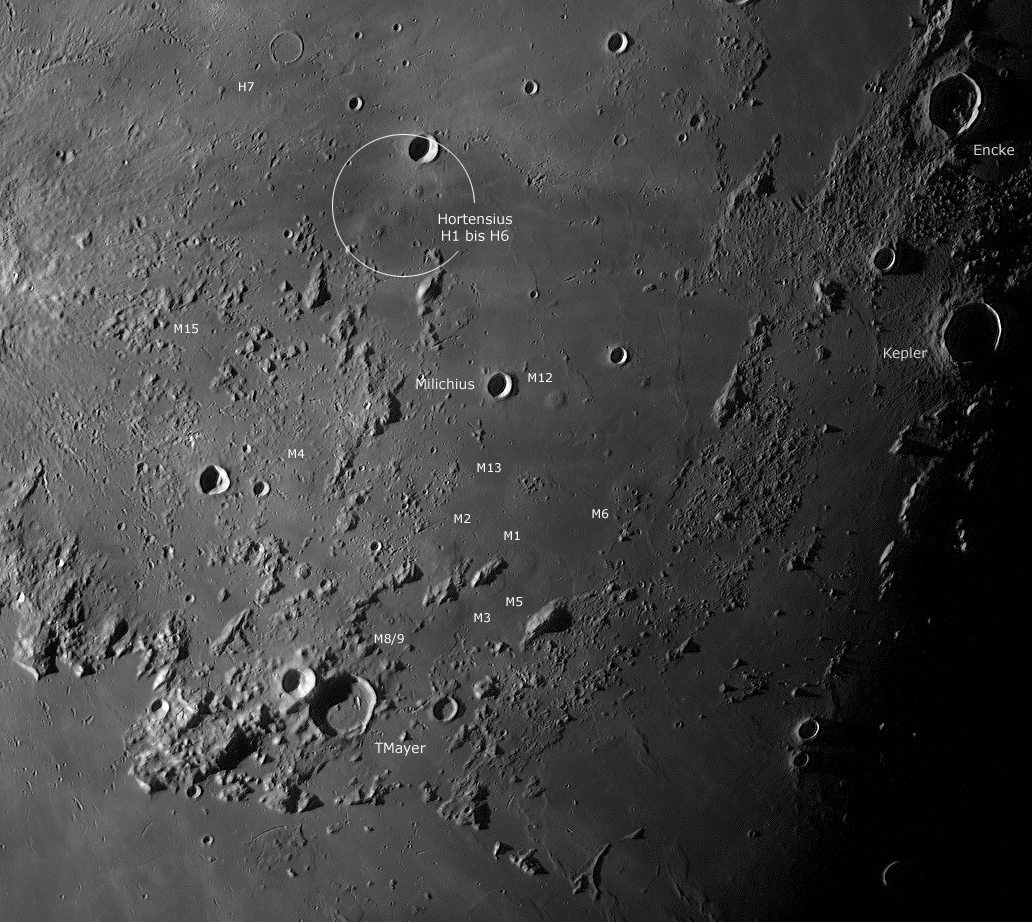 |
Hortensius and Milichius domefield Overview of the Hortensius and Milichius domes. The dome H 7 is slightly away from the crater Hortensius. It has a diameter of about 8 km at a height of 100 meter. |
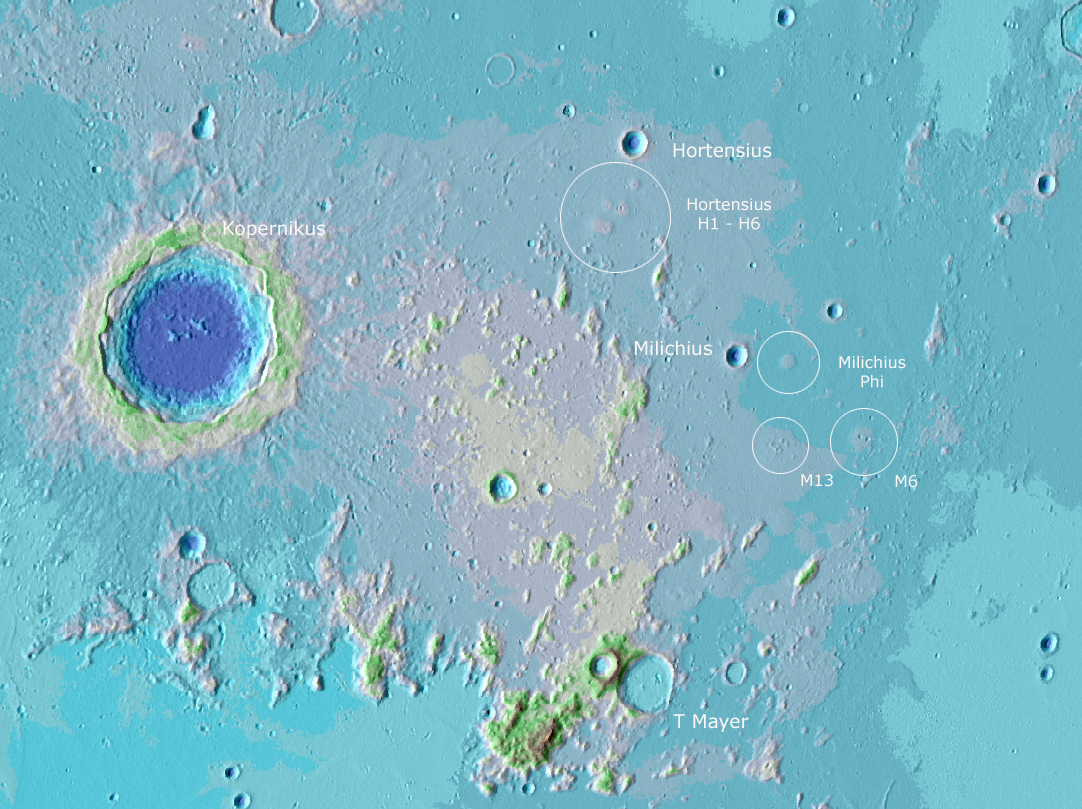 |
LRO height map of Hortensius and
Milichius
The image shows a height map of the Milichius and Hortensius "domeland" with a resolution of 500 m/px. The color coding shows how small the height differences between the domes and the surrounding area are. Also interesting is a height profil of Copernicus. The crater wall exceeds the surrounding landscape up to 700 meters and the crater floor lies at a depth of 2.5 kilometers. The Central Mountains are 1,000 meters above the crater floor. |
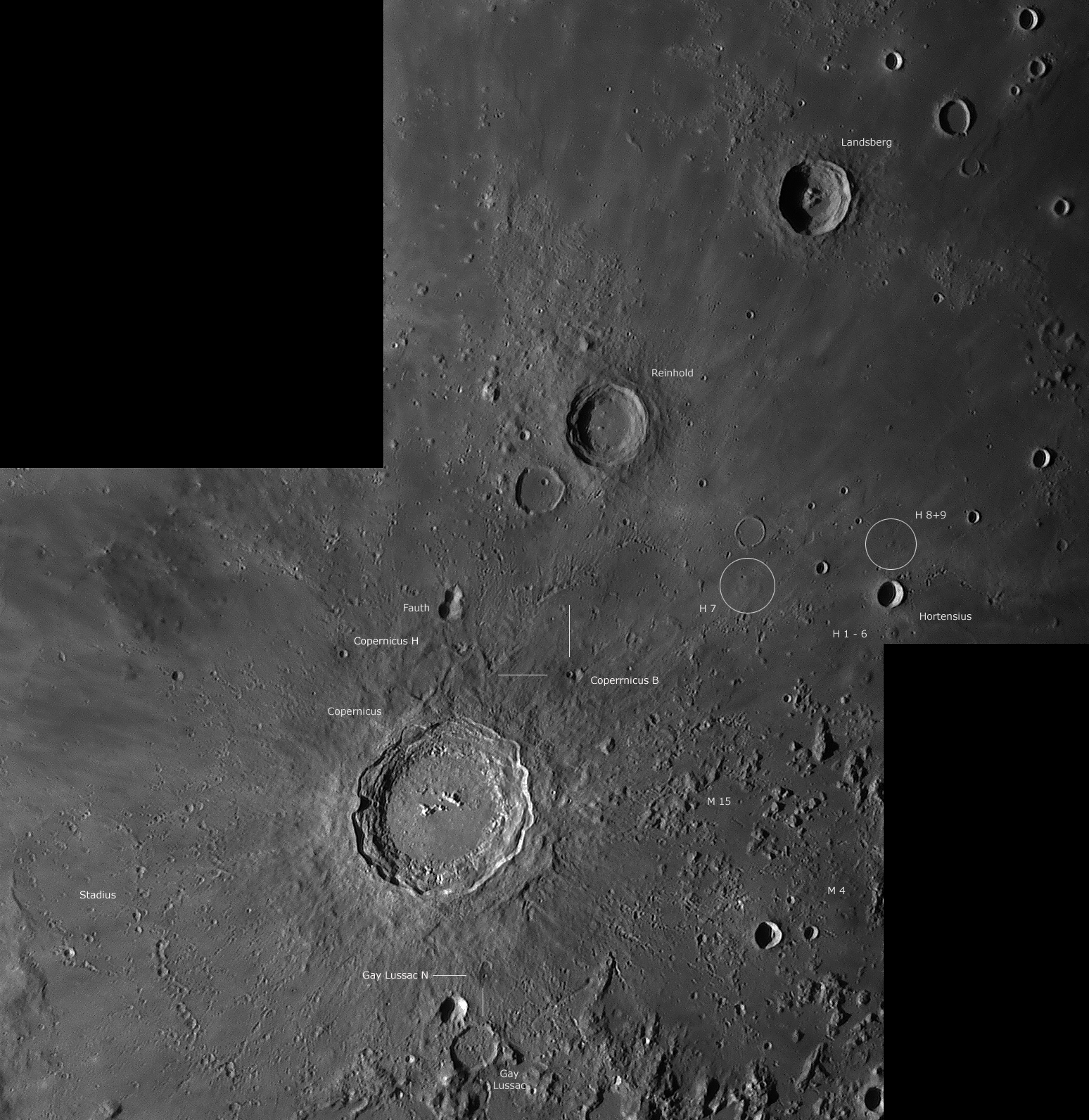 |
NEW 2016 HHortensius H7 - H 9 and 3 Dark Halo
Crater - Moon age 10.8
days (77 %) The image shows the small Hortensius domes H7 to H9. The domes have a diameter between 3.5 and 8 kilometers and heights between 65 and 100 meters. Furthermore, the three small dark halo crater Copernicus B and H and Gay Lussac N are marked. The two large Milichius domes M 4 (diameter 15 km, height 170 m) and M 15 (diameter 21 km, height 110 m) are also in the image. |
 |
NEW 2016 Milichius and Hortensius Dome fields- Moon
age 10.8 days (77 %) Overview of the Hortensius- and Milichius dome fields. Two putative domes north of the crater Tobias Mayer are marked with A and B . |
 |
NEW 2016 Dark Halo Crater near Copernicus
- Moon
age 12.3 days (89 %) The three small dark halo craters Copernicus B and H and Gay Lussac N at a moon age of 12.3 days. |
| top of the page |
 |
 |
 |
 |
 |
 |
 |
 |
 |
 |
 |
 |
| Segm. 01 | Segm. 02 | Segm. 03 | Segm. 04 | Segm. 05 | Segm. 06 | Segm. 07 | Segm. 08 | Segm. 09 | Segm. 10 | Segm. 11 | Segm. 12 |