 |
CHAMÄLEON + ONJALA OBSERVATORY DeepSky | SITEMAP HOME CHAMÄLEON |
|
 |
|||
| « zurück zur Startseite
galaktische Nebel « back to home galactic nebula |
Großes Bild laden - load large image 2048 x 1400 Pixel Aufnahmedaten Image data |
 Objektbeschreibung  Objekt
descripion |
The optical double star Zeta 1 and Zeta 2 in the constellation Scorpio
Unser Bild -
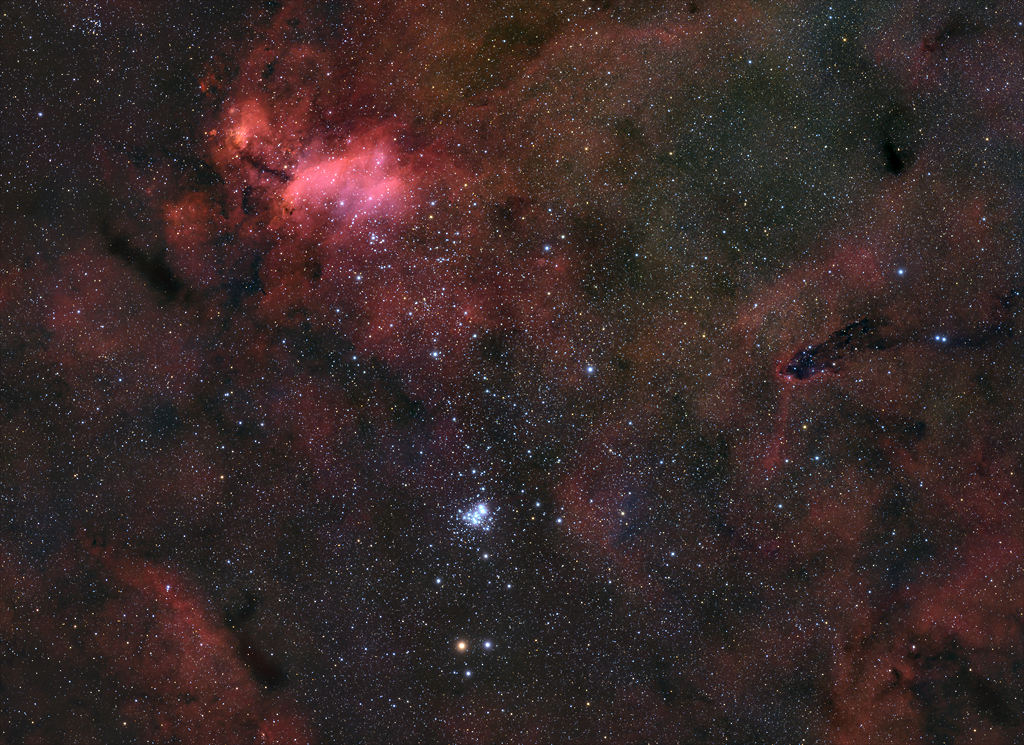
zeigt unten im Bild den optischen Doppelstern Zeta 1 und Zeta 2 im Sternbild Skorpion. Im Teleskop bieten beide Sterne bei einer visueller Beobachtung einen fantastischen Anblick, aber beide Sterne könnten nicht unterschiedlicher sein.
Zeta 1 (rechts) ist ein blauer Überiesenstern der Spektralklasse B1. Er hat etwa die 36-fache Masse unserer Sonne und ist einer der leuchtkräftigsten bekannten Sterne unserer Galaxie. Sein Durchmesser ist etwa 80x größer als der unserer Sonne und er ist etwa 6.000 Lichtjahre vom Sonnensystem entfernt.
Zeta 2 (links) ist ein gelb-orange farbiger Stern der Spektralklasse K5. Er ist mit etwa 6 Milliarden Jahre älter als unsere Sonne, hat etwa die gleiche Masse ist aber deutlich größer und er ist "nur" etwa 135 Lichtjahre vom Sonnensystem entfernt.
Die Bildmitte dominiert der offene Sternhaufen NGC 6231, der das Zentrum der Sco OB 1 Asoziation bildet. Es ist eine der größten Sternentstehungsregion unserer Galaxie. Oben im Bild IC 4628 mit 2 großen offenenSternhaufen, es ist der nördliche Teil der Sco OB 1 Asoziation. Westlich (links im Bild) liegt die kometaree Wolke DCld 343.0 + 2.8, eine weitere aktive Sternentstehungsregion.
Object description
Our image - shows the visual binary star system Zeta 1 and Zeta 2 in the constellation Scorpio at the bottom of the image. When viewed through a telescope, both stars offer a fantastic sight, but they couldn't be more different.
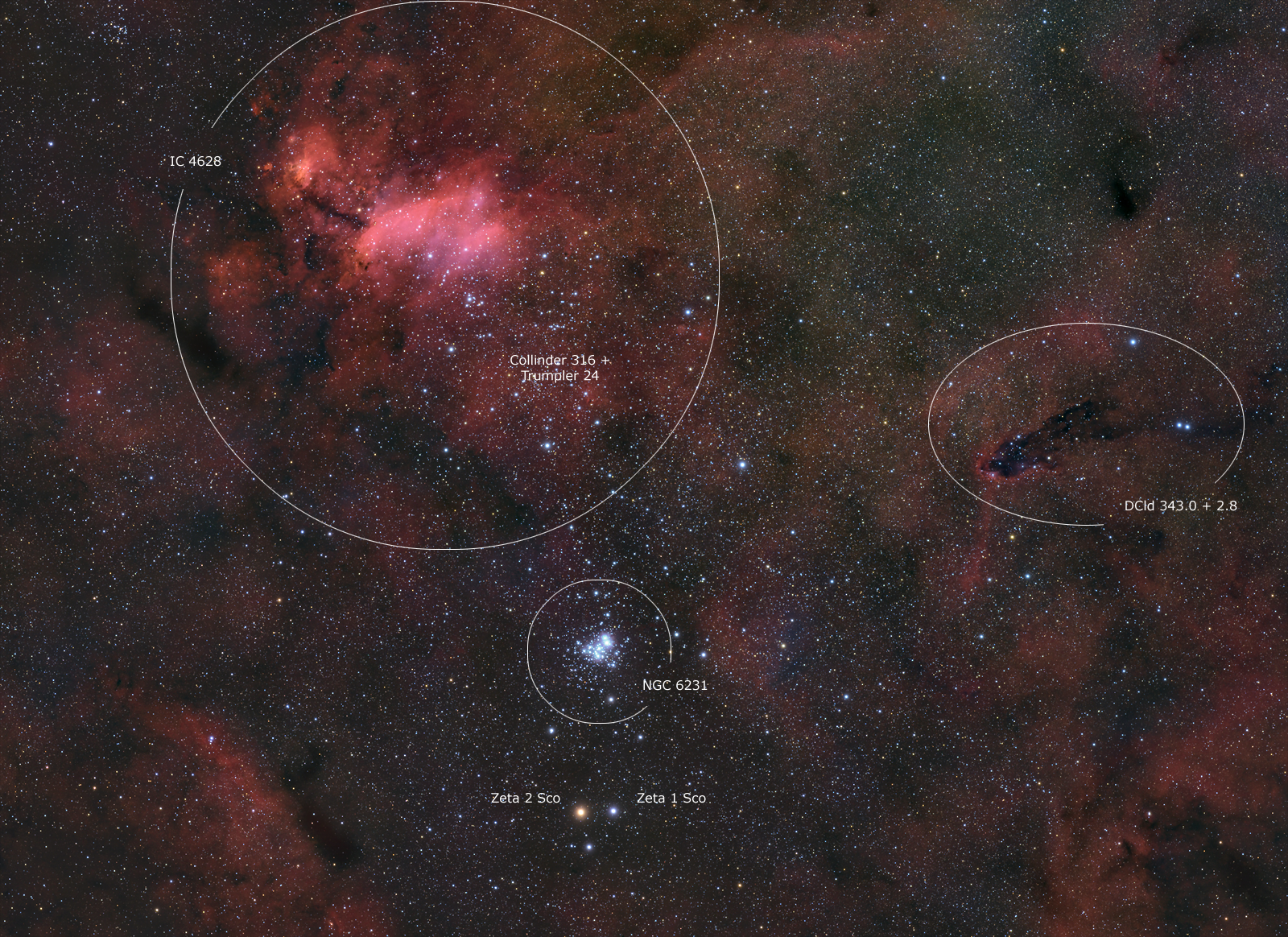 |
Zeta 1 (right) is a blue
supergiant star of spectral class B1. It has about 36 times the mass of our Sun
and is one of the brightest known stars in our galaxy. Its diameter is about 80
times larger than that of our Sun, and it is about 6,000 light-years away from
the solar system. Zeta 2 (left) is a yellow-orange star of spectral class K5. At about 6 billion years old, it is older than our Sun; it has roughly the same mass but is significantly larger, and it is "only" about 135 light-years away from the Solar System. The center of the image is dominated by the open cluster NGC 6231, which forms the center of the Sco OB 1 Association. It is one of the largest star-forming regions in our galaxy. At the top of the image is IC 4628, containing two large open clusters; this is the northern part of the Sco OB 1 Association. To the west (on the left in the image) lies the cometary cloud DCld 343.0 + 2.8, another active star-forming region. « Klicken Sie hier oder auf das Vorschaubild zum Laden einer großen Darstellung « Click here Click here or on the thumbnail to load a larger image |
Image data
May 2026 - 9 x 600 s, ZWO ASI 071 Pro, cooled
Telescope: Williams RedCat 51/250 mm
Location: Chamäleon Observatory, Onjala Lodge, Namibia
Image processing: DeepSkyStacker, PixInsight + Photoshop
 |
 |
 |
 |
 |
 |
 |
| Sonne | Mond | Sonnensystem | DeepSky | Weitwinkel | Verschiedenes | Spez. Projekte |