 |
CHAMÄLEON + ONJALA OBSERVATORY DeepSky | SITEMAP HOME CHAMÄLEON |
|
 |
|||
| « zurück zur Startseite
galaktische Nebel « back to home galactic nebula |
Großes Bild laden - load large image 1800 x 1400 Pixel Aufnahmedaten Image data |
 Objektbeschreibung Objektbeschreibung  Objekt
descripion Objekt
descripion |
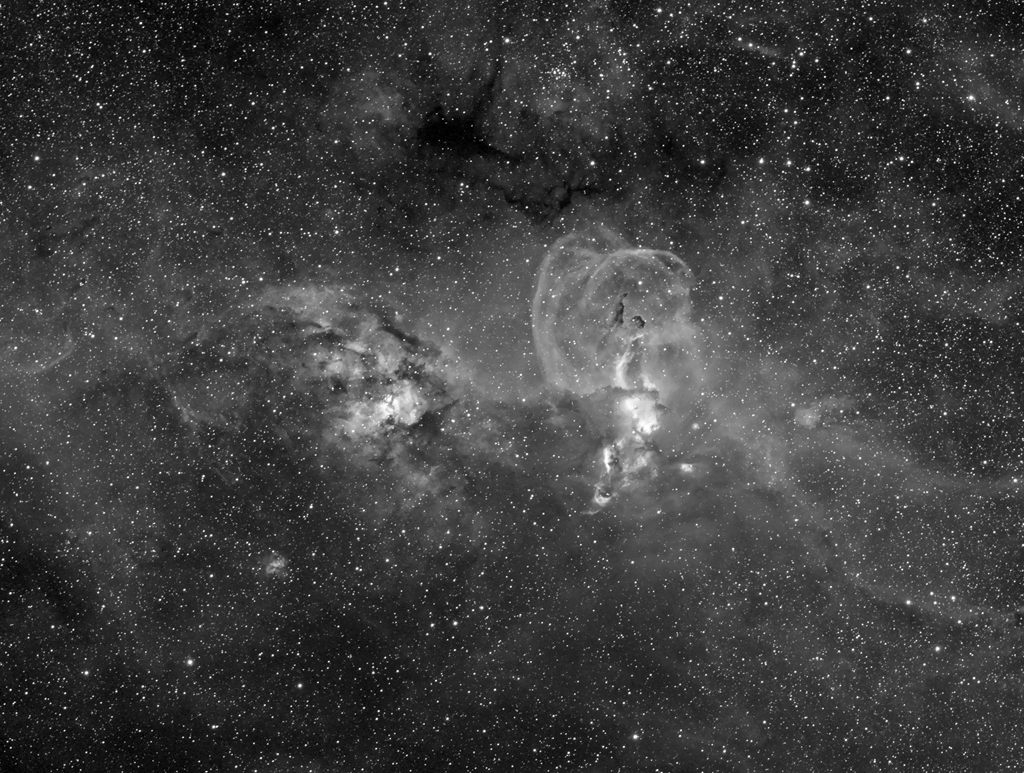
NGC 3579 und NGC 3603 - NGC 3579 ist ein heller H-II Emissionsnebel im Sagittarius-Arm der Milchstraße. Er hat einen Durchmesser von etwa 100 Lichtjahren und ist 9.000 Lichtjahre vom Sonnensystem entfernt. Er wurde am 16. März 1834 von John Herschel entdeckt. Diese Region beinhaltet 6 separate Nummern des NGC Katalogs.
Es wird angenommen, dass Episoden der Sternentstehung innerhalb des Nebels zu den komplexen Formen beitragen. Mächtige Winde von den eingebetteten, jungen, massereichen Sternen des Nebels formen die sich schlängelnden Filamente. Im nördlichen Bereich befinden sich 2 dunkle Thackeray Globulen. Interessanter ist der Bereich östlich von NGC 3579. Die Region ist als NGC 3603 katalogisiert. Es ist eine so genannte Starburst-Region, aus Gas- und Staubwolken bilden sich laufend neue Sterne.
Die H-II Region ist etwa 22.000 Lichtjahre vom Sonnensystem entfernt. Der zentrale Bereich beherbergt eine der dichtesten Ansammlungen extrem massereicher, heißer Sterne unserer Milchstraße, darunter mehrere seltene Wolf-Rayet-Sterne.
Object description
NGC 3579 and NGC 3603 - NGC 3579 is a bright H-II emission nebula in the Sagittarius Arm of the Milky Way. It has a diameter of about 100 light-years and is 9,000 light-years away from the solar system. It was discovered on March 16, 1834, by John Herschel. This region contains six separate entries in the NGC catalog.
It is suspected that episodes of star formation within the nebula contribute to its complex shapes. Powerful winds from the nebula's embedded, young, massive stars shape the meandering filaments. In the northern region, there are two dark Thackeray globules. Of greater interest is the area east of NGC 3579. This region is cataloged as NGC 3603. It is a so-called starburst region, where new stars are continuously forming from clouds of gas and dust.
The H-II region is approximately 22,000 light-years away from the solar system. The central region contains one of the densest clusters of extremely massive, hot stars in our Milky Way, including several rare Wolf-Rayet stars.
Image data
06.05.2026 - total 12 x 600 s, ASI 1600 Mono Pro + Baader H-alpha Filter, HWB = 7 nm
Telescope: Pentax SDP 105 at f = 670 mm
Location: Chamäleon Observatory, Onjala Lodge, Namibia
Image processing: DeepSkyStacker, PixInsight + Photoshop
 |
 |
 |
 |
 |
 |
 |
| Sonne | Mond | Sonnensystem | DeepSky | Weitwinkel | Verschiedenes | Spez. Projekte |